Pillow Materials & Sleep
Down Pillow Labels Decoded: Fill, Shell, and Support
A pillow’s name can suggest softness or luxury, but the details that shape how it feels are on the label: what is inside, how much of each material is used, what surrounds the fill, and how the pillow is built.
Published November 5, 2026
A down pillow can feel airy and yielding, or structured enough to hold its shape beneath the head. A feather pillow may feel firmer and more substantial. A blend can sit somewhere between the two—or combine the qualities in a more deliberate way. The words on the product label offer clues, but they do not always tell the whole story.
To compare pillows, start by separating four questions that are often bundled together: What is the fill? In what proportion? What does the shell contribute? And how does the construction affect the way the pillow responds to pressure? Fill percentages, fill power, shell fabric and stitching each describe different things. None, on its own, guarantees a particular level of comfort or support.
The distinction matters because the pillow is not merely a cushion of feathers or down. It is a small, layered system. The filling creates much of its loft and resilience; the shell contains that filling and touches the sleeper; construction influences whether the material shifts, compresses or stays in place. Reading those elements together gives a more useful picture than relying on a name such as “soft,” “plush” or “hotel.”
First, what “down” and “feather” mean
Down and feathers are not interchangeable terms. Down consists of soft clusters that grow beneath the outer feathers of waterfowl. A cluster has a central point with fine filaments branching outward, creating a light structure that can trap air. Feathers have a more defined central shaft, or quill, with barbs extending from it. They tend to be heavier and more structured than down clusters.
In a pillow, those differences often show up as a contrast in feel. Down is commonly associated with lightness, loft and a soft, compressible hand. Feathers can lend more body and shape, and a feather-rich fill may feel firmer or denser. These are tendencies rather than guarantees: fill quality, quantity, chamber design, shell and pillow dimensions all affect the result.
Labels may use “down,” “feather,” “down and feather,” or a named blend. The exact wording depends on the product and the rules that apply in the market where it is sold. Look for a full material statement rather than treating a headline phrase as a complete specification. If the label says “down pillow” but also lists feathers, the listed composition is the more precise guide to what is inside.
Feathers can sometimes be felt through a thin or poorly constructed cover, particularly if quills press against the fabric. A tightly woven, appropriately designed shell can help contain the fill. That does not mean a specific fabric guarantees a particular result: shell weave, finishing and construction matter too.
How to read the fill percentage
A fill percentage describes the relative composition of the filling. A pillow marked 90% down and 10% feather contains a different balance from one marked 75% feather and 25% down. The first is more down-dominant; the second contains a larger share of feathers. If percentages are provided, they are a more useful basis for comparison than a product name alone.
Composition does not directly tell you how high the pillow will sit or how firmly it will support your head. A larger percentage of down may suggest a lighter, more yielding fill, but total fill weight and pillow design also count. A pillow with a high down proportion can still compress substantially under pressure; one with a feather core or a heavier fill may hold its shape more firmly. “Soft” and “firm” can also be subjective descriptions, so treat them as starting points, not measurements.
Some designs deliberately divide the fill into chambers. A feather-rich core may provide structure while softer down in outer chambers adds cushioning. That arrangement is different from a uniform blend, even if the total material percentages appear similar. When a label or product description mentions an inner core, outer chambers or layered fill, those construction details can help explain the intended feel.
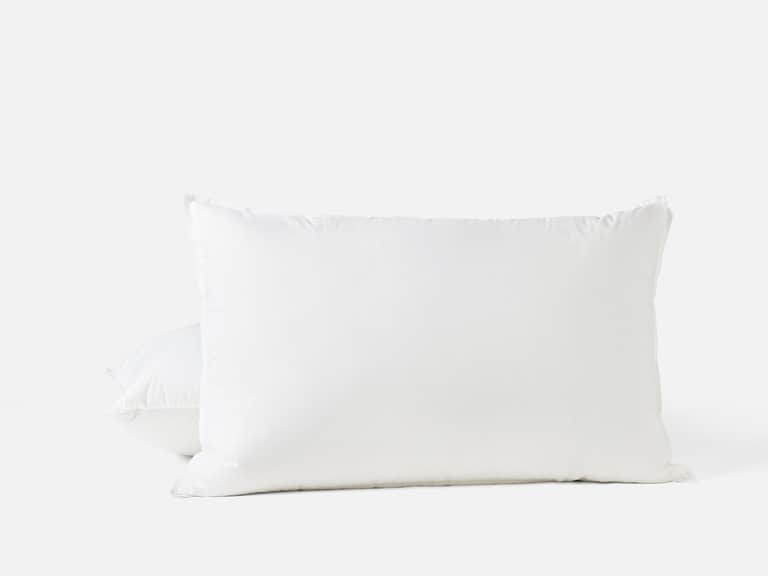
Consider the Goose Down Pillow listed on this site as an example of why it pays to read beyond the name. Its description specifies 90% white goose down and 10% white goose feather, an 800 fill-power figure, and an organic cotton percale shell. Those are three separate pieces of information: composition, a measure associated with down cluster loft, and the fabric enclosing the fill. None should be mistaken for the others.
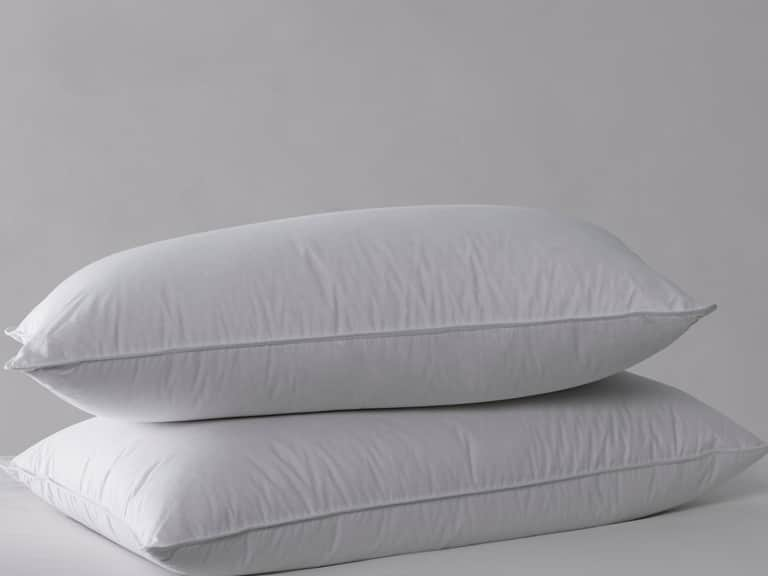
By contrast, a pillow described as filled with 100% feathers represents a substantially different fill category. A Feather Pillow in the site’s materials list is described with a 100% feather fill and a cotton outer shell. That label suggests a feather-based construction; it does not, by itself, specify how high the pillow will feel or how it will suit an individual sleeper. Those questions require more detail about quantity, dimensions and construction, as well as personal testing where possible.
Fill power is not fill percentage
Fill power is one of the most commonly misunderstood numbers on down products. It is not the percentage of down in the filling, the amount of down by weight, or a direct rating of softness. It is a measure related to the loft of a given weight of down under a specified test method. Higher fill power generally indicates that the down can occupy more volume for its weight, but the number describes a property of the down—not the complete experience of the pillow.
That distinction matters. A pillow labeled 800 fill power is not necessarily “80% down,” and the number does not tell you whether the pillow contains a small or large amount of filling. To understand composition, find the fill percentage. To understand the loft potential of the down portion, consider fill power. To estimate the finished pillow’s support, look at those facts alongside fill weight, size and design.
Even two pillows with the same fill power can feel different. They may contain different amounts of fill, use different proportions of feathers and down, or have distinct chamber layouts. A larger pillow may distribute its filling across a greater area. A tightly packed design may feel more substantial than a loosely filled one. And pressure from the sleeper’s head and shoulders changes how a pillow compresses in use.
For this reason, avoid turning a single specification into a universal ranking. Higher fill power may be meaningful when comparing down of similar type and construction, but it does not automatically mean a pillow is better, firmer or more suitable. A useful comparison holds as many other factors constant as possible: size, fill composition, amount, shell and construction.
The shell is more than a cover
The shell is the fabric enclosure around the filling. It can influence how the pillow feels against the face, how readily air moves through the fabric, how well the fill stays contained and how the pillow responds when compressed. Common shell descriptions include cotton, cotton percale and cotton sateen. These names tell you something about fiber or weave, but not every detail of performance.
Perсale generally refers to a plain weave with a crisp, matte hand. Sateen uses a different weave structure that can produce a smoother, often silkier surface. The particular yarns, fabric weight, finishing and construction still matter. “Cotton” alone does not tell you whether the fabric is tightly woven or whether the shell is designed to contain down and fine feathers.
For down and feather pillows, the shell needs to hold the filling securely. A down-proof or down-resistant description indicates an intention to limit migration through the fabric, though no phrase should be taken as a promise that a pillow will never leak. Stitching, seams and the condition of the shell contribute to containment too. A closely woven cover may also feel less airy than a lighter fabric, so there can be a practical balance between containment and breathability.
Organic status is another separate question. A shell made from certified organic cotton concerns how the cotton was produced and processed under a particular certification’s requirements. It does not establish the origin or composition of the down or feathers inside. Similarly, animal-welfare or down-sourcing standards, when claimed, address sourcing criteria rather than organic status of the fabric. Read each claim as applying to the material or part of the supply chain it actually covers.
Certification names can be useful, but they are not substitutes for a clear bill of materials. Check whether a claim applies to the shell, fill, finished product or manufacturing facility. If a product description uses broad terms such as “natural,” “clean” or “eco-friendly,” look for the specific material, certification and scope behind the wording.
Construction changes the feel
Two pillows with matching fill percentages and shell fabrics may still behave differently because their interiors are assembled differently. A single-chamber pillow holds its fill together in one space. A multi-chamber design divides the interior into sections, which can help create different zones of firmness or softness. One common approach pairs a more structured center with softer outer chambers; another uses partitions to limit the movement of filling.
Stitching and seams affect more than appearance. A chambered pillow may be designed to keep materials in defined areas, while a simple construction may allow more shifting as the pillow is shaken or compressed. The shell’s quilting or internal divisions can also affect where the fill settles. Product descriptions that mention a core, chambers, baffles or compartments are offering clues about how the pillow is organized.
Construction does not eliminate the need to consider maintenance. Fill may settle with use, and a pillow may need regular fluffing to redistribute it. A pillow that can be washed at home requires careful drying according to its care label; any remaining moisture inside a dense fill can create problems. Other pillows may be spot-clean only or recommend professional laundering. The correct choice is not simply the easiest-sounding instruction, but the one you can realistically follow.
Care details are especially important for down. Washing can cause clusters to clump temporarily, and thorough drying is essential to restore loft and prevent dampness from lingering. Follow the maker’s directions rather than assuming that a household washer and dryer are suitable. If the pillow is machine washable, note the specified cycle, detergent, temperature and drying method. Use a protector and pillowcase if recommended; those washable layers can reduce how often the pillow itself needs cleaning.
Support depends on the sleeper, not just the label
A pillow’s job is to help keep the head and neck in a comfortable position in relation to the rest of the body. The right height and firmness depend on factors including sleep position, shoulder width, mattress firmness and personal preference. A label that says “medium” cannot account for all of them.
Side sleepers often need more height to bridge the space between the shoulder and head, while back sleepers may prefer a lower profile that does not push the head too far forward. Stomach sleepers commonly prefer a flatter pillow, or sometimes no pillow beneath the head, though individual comfort varies. These are broad guidelines, not medical rules. Pain that persists or worsens merits advice from a qualified health professional rather than relying on a pillow label as treatment.
Fill composition can influence how a pillow adapts when pressure is applied. A down-rich fill may compress and mold around the head, while a feather-heavy fill may feel more structured. A blend can aim to combine pliability with shape retention. But the final support also depends on the amount of filling and how it is arranged. If adjustable fill is available, it may offer more flexibility; if not, check return and trial terms before choosing a pillow that cannot be tested in person.
Allergy language deserves care as well. “Hypoallergenic” is not a guarantee that a person with allergies will have no reaction. People may be sensitive to different materials, dust or residues, and a claim about processing does not replace an individual assessment. A washable protector and regular laundering of the outer layers may help with ordinary cleanliness, but anyone with a known allergy should seek appropriate clinical guidance and review the full materials list.
A practical label-reading checklist
When comparing a natural feather pillow or down-and-feather blend, work through the label in a consistent order. This makes it easier to distinguish specifications that answer different questions.
- Identify the fill. Is it down, feathers, or a combination? Note whether the description names the bird type and whether the product includes materials beyond the primary fill.
- Find the percentages. Compare the proportions of down and feathers. Do not infer them from a product name or from fill power.
- Look for fill power. Treat it as a down-loft specification, not a percentage, weight or direct firmness rating.
- Check fill weight and dimensions. These help put the composition into context. A percentage alone does not tell you how much material is in the pillow.
- Read the shell description. Note the fiber, weave, and any claim that the fabric is designed to contain down. Check whether certification applies to the shell or another component.
- Look for construction details. Core, chambers, baffles, quilting and compartment descriptions can explain how filling is distributed.
- Review care instructions. Confirm whether the pillow is washable, spot-clean only or best handled professionally, and whether you can dry it thoroughly.
- Assess sourcing claims separately. Organic textile certification, animal-welfare claims and fill composition address different matters. Verify which material or process each statement covers.
- Match the design to your needs. Consider sleeping position, preferred height, temperature comfort and whether a moldable or more structured feel suits you.
If important information is missing—such as the precise fill ratio, shell fiber or care method—ask the manufacturer or retailer before comparing the pillow with a more fully specified option. A polished product name is not a technical specification.
What labels cannot tell you
Labels can describe materials and construction, but they cannot reproduce the experience of sleeping on a pillow. They do not reveal exactly how a particular sleeper will perceive its loft, how it will settle after months of use or how it will interact with a mattress. Product descriptions are useful starting points; they are not a substitute for a return policy, a realistic trial or personal experience.
They also do not automatically prove broad claims about health or environmental impact. A natural fill is not automatically sustainable in every respect, and an organic shell does not make every component organic. A recycled fill, a certified fiber and a responsibly sourced animal material are distinct attributes. Each can be relevant, but each should be described with precision rather than combined into a vague promise of a “green” pillow.
For shoppers who want to minimize unnecessary replacement, durability and repairability matter alongside the initial material choice. A removable, washable cover may protect the filling. A pillow that can be refreshed or adjusted may remain useful for longer, depending on its design. Keeping the product dry, using a protector and following care instructions are straightforward ways to preserve its condition.
The clearest comparison is the most complete one
When two down pillows have similar names, compare the facts in layers. Start with the composition percentage. Then consider fill power and amount, keeping in mind that they describe different aspects of the fill. Examine the shell and its weave, followed by chambering and stitching. Finally, weigh care requirements and the support profile you are actually looking for.
In the end, a number is useful only when you know what it measures. Fill percentage tells you the relative mix. Fill power describes the loft of down under a stated testing approach. Shell information identifies the fabric around the filling. Construction explains how the components are arranged. Support emerges from all of those details, filtered through the sleeper’s body, position and preferences.
That is the quiet logic behind a well-read pillow label: no single claim does all the work. A careful comparison turns a crowded list of specifications into a practical decision—and helps distinguish a soft, down-rich pillow from a feather-structured one before either reaches the bed.